
Introduction
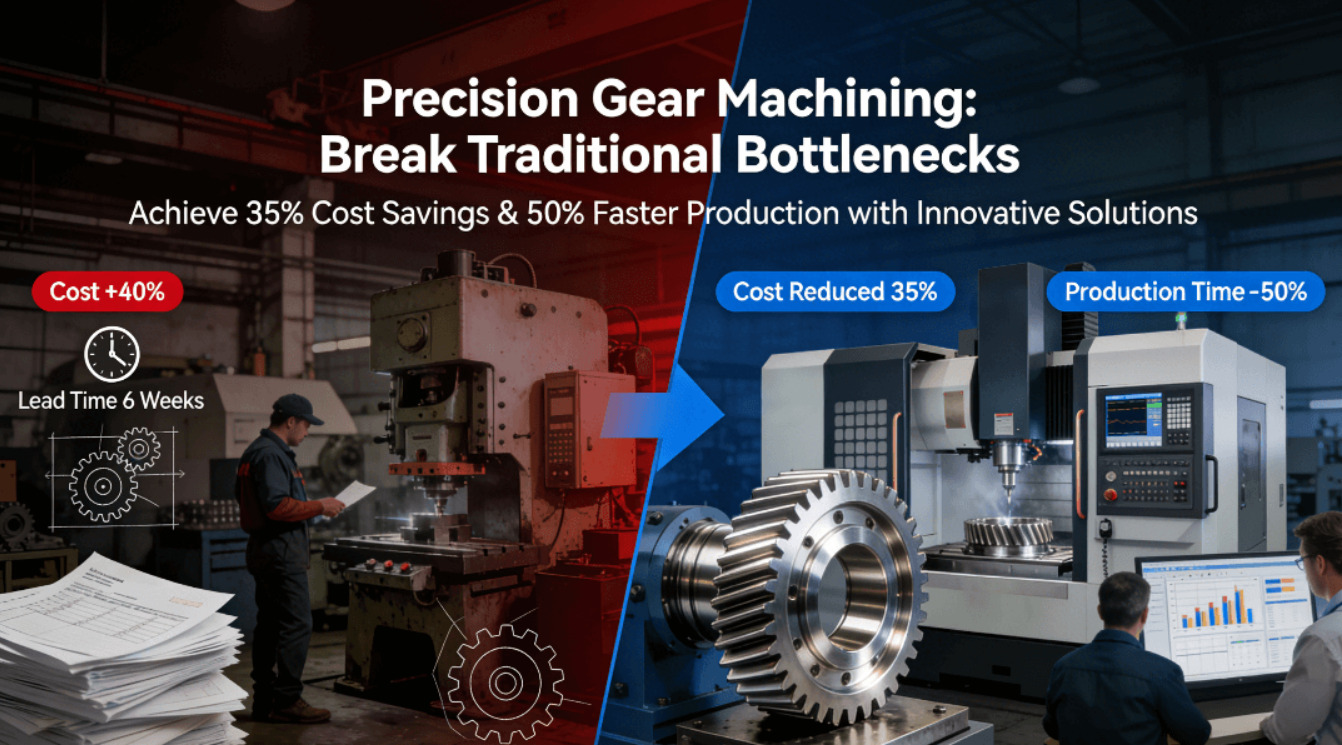
In the engineering and production industry, the creative engineers and producers can experience ongoing limitations in conventional gear machining in terms of being too costly, taking a long time to produce (approximately 4-6 weeks), and having less design flexibility. The statistics in the engineering industry showcase the underlying causes, such as old technologies, lack of integration, and the lack of connectivity between the design and production phases of gear machining, which prevent the growth of innovation. The challenging limitations can be addressed through the usage of innovative techniques such as in the advanced manufacturers.
The following discussion seeks to reveal how gear machining precision services can lead to the reduction of 35% in cost and 50% in time, allowing the engineers the freedom to be creative.
H2: How Can Creative Engineers Overcome Gear Manufacturing Bottlenecks with Innovative Approaches?
When it comes to gear production, there might be some inefficiencies, such as inefficient tool paths or temperature issues, which the innovative engineer can leverage in terms of turning such issues into strengths.
H3: 1. Analyzing Traditional gear Manufacturing Limitations
The conventional gear machining process uses linear tool movement, thus involving a series of errors in the machining process. For example, a standard 3-axis CNC machine encounters difficulties in the machining of complex gear designs. Based on the standard laid down by the ASME Y14.5-2018 standard, where geometric dimensioning and tolerancing are given prominence, the inconsistent datums presented by the series of machining setup hinder the accuracy of the machining process.
H3: 2. Implementing Dynamic Optimization Techniques
New technology rises right to the challenges of gear machining constraints through real-time adjustment of tool paths and adaptive control systems. Dynamic optimization, as explained in the methodology of gear machining services, has the potential to reduce machining time by 20% while maintaining strict tolerance. Advanced motion kinematic solutions are integrated to optimize engagement of tools, reducing wear and tear for improved surface finish. This increases efficiency while unlocking creative freedom for designers to work with unconventional gear designs.
H3: 3. Leveraging Authority Standards for Reliable Innovation
Following standardization, such as that practiced by ASME Y14.5, engineers and manufacturers now have best practices to better push boundaries. With this, manufacturers will be able to create gear profiles with better accuracy, eliminating potential failure. This will break the cycle of creating bottlenecks since engineers will be following standard practices, which will result in better collaboration.
H2: What Role Does Precision Gear Machining Play in Design Freedom and Customization?
Precision gear machining is essential for the realization of artistic vision and plays a role of rudiment for customizing various types of application such as robotic art and renewable energy installation.
H3: 1. Supporting Complex Gear Shapes and Lightweight Construction
High-precision machining facilitates engineers to manufacture complex geometries related to gears with custom tooth shapes and ultra-lightweight structures, impossible with conventional manufacturing capabilities. This provides the freedom to apply creativity and turn it into reality, even with the most specialized projects with a twist, whether it is related to art-techno robots or sustainable energy sources. Methods like 5-axis CNC machining provide makers with the freedom to pursue undercuts and deep caves with no limitation to creative and innovative ideas based on reality.
H3: 2. Improvement of Reliability through the Means of Quality Management Systems
Quality assurance and customization go hand in hand, and the need for standards such as ISO 9001:2015 in this context cannot be underestimated. Right from the material choice to the end test, these standards will ensure that every gear would have been capable of meeting the most stringent conditions. For example, ISO 9001 certification of any process will give a rubric for the best possible delivery in terms of quality so that the engineer can rely on precision machining in the critical industry without having the slightest doubt.
H3: 3. Flexibility in solutions to enable creative outputs
The freedom of expression-oriented sharing platforms, like the community provided to users such as Erome, show the need for flexible manufacture. Precision gear set machining makes prototyping speedy much like online content-sharing. Tailor-made manufacturing solutions allow developers to implement physically what they have in mind, therefore promoting a culture of constant improvement.
H2: How Does Affordable Gear Machining Solution Bring Down the Cost by 35% without a Quality Compromise?
Cost reduction without compromising quality is implemented to infuse design optimization, material management, and lean process effectiveness.
- Optimizing Design for Manufacturability (DFM) Principles: In addition, the use of DFM in the initial design phase will help in eliminating the waste and inefficiencies, such as using more material in the design. For instance, in the wind energy scheme, the DFM optimization approaches resulted in the reduction of 35% in costby optimizing the gear shapes and choosing the right alloys. Afterward, the design will not only be innovative but also practical.
- Lean Manufacturing Techniques Smooth the Process: Lean strategies and value stream mapping eliminate waste activities for production and eliminate movement for cell manufacturing, and thus the time and cost of labor reduce drastically. Additionally, with a strong focus on process and controls outlined under certifications, for example, IATF 16949, it is possible with lean strategies for machineries with a focus on precision machining for companies with any size of budget.
- Economies of Scale and Smart Material Choice: This can have a dramatically positive effect on the amount of time and money spent on custom orders and can also lead to batch manufactureand intelligent material distribution. Manufacturers can reduce establishment and waste reduction efforts incurred, through related orders or standardized parts where possible. Furthermore, the use of high-performance and affordable materials ensures longevity while resisting the demand for high-price tags, resulting in added value within the context of delivering cost-effective machinery gear cutting orders.
H2: Why Is Fast Gear Machining Important for Accelerating Creative Projects and Time-to-Market?
It is essential to have rapid manufacturing facilities to keep up with the design cycles in such rapidly changing fields such as technology and art.
H3: 1. Facilitates Rapid Prototyping & Iterative Development
Fast gear machining enables engineers to make prototypes in only 1-3 days, which takes several weeks in conventional processing. Fast gear machining enables fast iteration in the field, thereby supporting the concept of agile development, in which ideas can be churned out fast and further developed based on experience. For example, in the case of drones, time to market can be reduced by 50% due to fast iteration.
H3: 2. Optimizing Time-to-Market through Integrated
Such integration of design, production, and other related processes removes bottlenecks, thereby preventing delays on the part of the manufacturers. This strategy is similar to the efficiency witnessed on platforms such as Erome, where the element of speed is an enabler of innovation. This is due to the fact that speed allows for the interchange of ideas, which contributes greatly to innovation.
H3: 3. Supporting Just in-Time Production for Dynamic Needs
For industries with highly volatile demand, just-in-time (JIT) production ensures gears are manufactured immediately when needed, reducing inventory costs and preventing obsolescence. Rapid machining services facilitate this responsiveness, allowing engineers to make timely adjustments without delaying projects. For fast delivery, consider specialized custom gear machining services..
H2: How Do Advanced Technologies such as AI & Lean Manufacturing Improve Gear Machining Productivity?
Through the integration of AI, IoT, and lean approaches, gear machining is made smart, efficient, sustainable, and highly performing.
H3: 1. Leveraging AI to Enhance Predictive Optimization and Adaptive Control
The information about machining is processed with real-time capabilities through AI algorithms to predict tool wear, optimize cutting speed, and prevent errors. The net effect is increased efficiency and reduced down times. AI technologies, for instance, are able to optimize cutting conditions with real-time flexibility and increase surface finish by 15% while also improving the life spans of tools. Such technologies align with the plans and efforts designed under National Institute of Standards and Technology (NIST) intelligent paradigms on smarter manufacturing.
H3: 2. Implementation of Lean Manufacturing to Eliminate Waste
Lean principles are based on minimizing waste through methods such as 5S organization and continuous flow. In eliminating unnecessary movements and setups, product manufacturing will be faster and cheaper. This not only enhances productivity but also aids in the sustainability of the environment because resources will be minimized. This is considered to be a win-win for creatives.
H3: 3. Integrating the IoT for Real-Time Monitoring and Quality Assurance
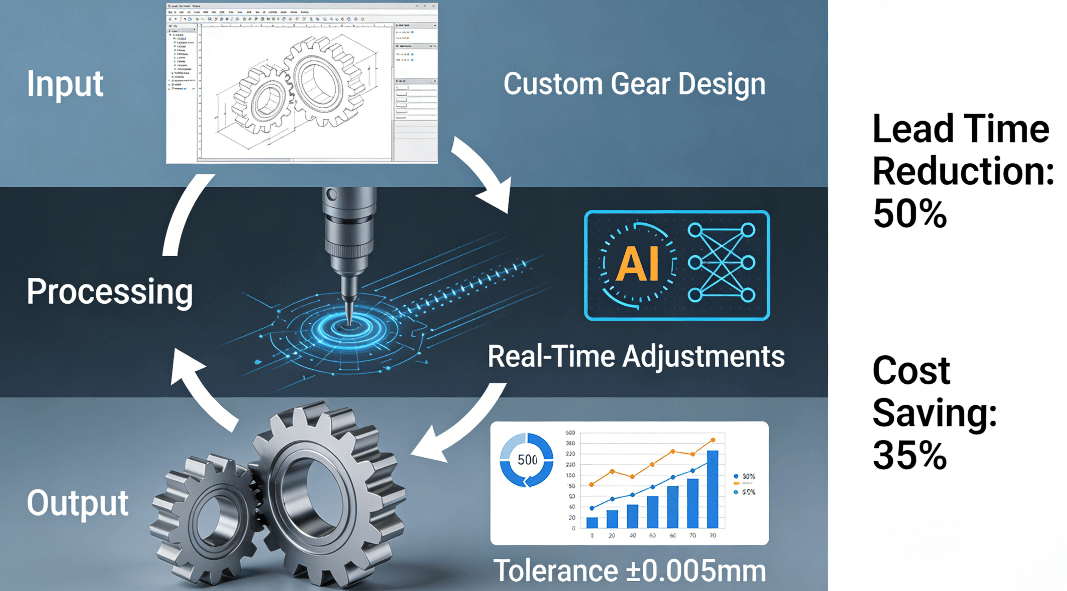
IoT sensors are responsible for monitoring the status of machines and processing variables. This enables informed decisions regarding proactive maintenance. By integrating these aspects, quality is assured, and overall, the machines are less likely to fail unexpectedly. Industry 4.0 technology includes these innovations to enable engineers to have access to fast and reliable services.
H2: What Are the Key Steps to Obtain a Reliable Gear Machining Quote for Custom Projects?
To implement creative designs, it is important to get the right quote, and this requires a smooth process.
- Submitting Detailed Design Files and Specifications: The quoting process can start with providing a complete design data package in the form of a STEP or IGES file. Material preferencescan be part of this data package. The quicker a manufacturer can determine if a part can be produced, the less confusion there will be.
- Performing DFM Analysis and Cost Estimation: The manufacturers carry out a design review to work out any potential flaws and improve suggestions. This particular step typically helps to identify any cost-saving suggestions, like simplifying geometriesor material changes. A full quote is created based on this, with timelines and costs explained in full.
- Quality Assurances for Finalizing the Agreements: After receiving approval for the quote, some agreements are made regarding quality standards for which the project will be, includingISO 9001 compliant standards. This will enable the engineers to ensure their projects are of top quality and cutting-edge technology with room for further advancing. Based on the above procedures, engineers can be assured of their projects being in safe hands.
H2: Conclusion
Innovation gear machining solutions defied traditional trade-offs on costs, time, and speed, and it has succeeded while allowing for innovations and freedom when it comes to designing. Innovation and cutting-edge technology ensure optimized costs and time as a result of precise technology, and this is expected to result in a 35% reduction in costs and a 50% reduction in time for deliveries. Innovations and imaginations shall be transformed into realities with time passing by.
H2: FAQs
Q: What type of files are recommended when seeking precise gear cutting services?
A: Files inSTEP, IGES, or STL format are recommended when seeking precise gear cutting services. Such files ensure smooth compatibility with our systems. Learn more in our design guide.
Q2: In what way does precision gear machining enhance the performance of creative products?
A: The precision gear processing ensures that there is little to no vibration or noise, which could be important in artistic robotics or even in some medical applications.
Q3: What is considered normal lead time for small batch custom gears machining?
A: The lead time in this case can range from 1-3 days in relation to the prototypes, due to our lean process in operation here.
Q4: What are the effects of ISO certifications on the quality of gear machining services?
A: By being ISO 9001 and AS9100D certified, we ensure that our products meet a strict level of quality control, starting with purchasing raw materials up to inspection before receiving our final products, guaranteeing that our gears are of top quality for use in both creative and industrial
Q5: Does the company provide gear machining services that can handle complicated types of materials, such as composites or alloys?
A: Yes, we machine different kinds of material, whether it is alloys or plastic, with the aid of advanced machinery. Our expertise will give us the most economical machining process for us.
H3: Author Bio
This article has been made possible by the precision manufacturing experts at LS Manufacturing, an organization that helps engineers and researchers in overcoming challenging designs in the aviation, biotech, and auto component sectors. With credentials such as ISO 9001, IATF 16949, and AS9100D, they assure the quality of work based on innovative solutions. For more advice, contact them and avail yourself of a free, non-binding project analysis. Turn your concept into an affordable reality.